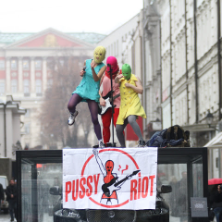
Pussy Riot is a Russian feminist protest art and music collective founded in Moscow in 2011. The group gained international recognition through provocative performances that combine punk music, performance art, political activism, and social protest. Founded by Nadya Tolokonnikova, Pussy Riot has operated as an open collective with a rotating membership of artists and activists. Members typically perform anonymously while wearing brightly colored clothing and distinctive knitted balaclavas, which have become an iconic symbol of the group's identity.
From the outset, Pussy Riot has used public spaces as stages for unauthorized guerrilla performances addressing political and social issues. Their work focuses on feminism, LGBTQ+ rights, freedom of expression, human rights, and criticism of Russian President Vladimir Putin, his policies, and the close relationship between the Russian state and the Russian Orthodox Church. These performances are filmed and released online as music videos, allowing the collective to communicate its message to audiences around the world.
The collective achieved worldwide prominence in 2012 following its "punk prayer" performance inside Moscow's Cathedral of Christ the Saviour. The action sparked widespread political and cultural debate, leading to the arrest and conviction of Nadya Tolokonnikova, Maria Alyokhina, and Yekaterina Samutsevich on charges of hooliganism. Their trial drew intense international attention and became a global symbol of debates surrounding artistic freedom, political dissent, and human rights in Russia. Amnesty International designated the imprisoned members as prisoners of conscience.
Following these events, Pussy Riot continued its work through music, artistic projects, and political actions. Over time, the collective's sound evolved from raw punk rock toward a broader style incorporating pop and electronic influences while maintaining its strong activist message. The group has released multiple EPs, studio albums, singles, and multimedia projects and has collaborated with a variety of international artists across different genres.
Today, Pussy Riot is regarded as one of the world's most recognizable examples of politically engaged contemporary art. Their work extends beyond the traditional concept of a band by combining live music, performance art, visual expression, and activism into a multidisciplinary artistic practice. Despite the controversies surrounding their activities, Pussy Riot has had a lasting impact on global culture and continues to be widely recognized as a symbol of artistic resistance, civic activism, and the defense of freedom of expression.